
Seed that stays where we spray it
Hydroseeding in Providence, RI
New lawns, slopes and construction sites seeded with mulch, fiber and tackifier, timed for New England's seeding windows.
- No-charge site visit, then an itemized quote in writing
- Seed mix picked for the sun, shade and slope on your lot
- A printed aftercare sheet: when to water and when to mow for the first time
Growing Grass on Glacial Ground by the Bay
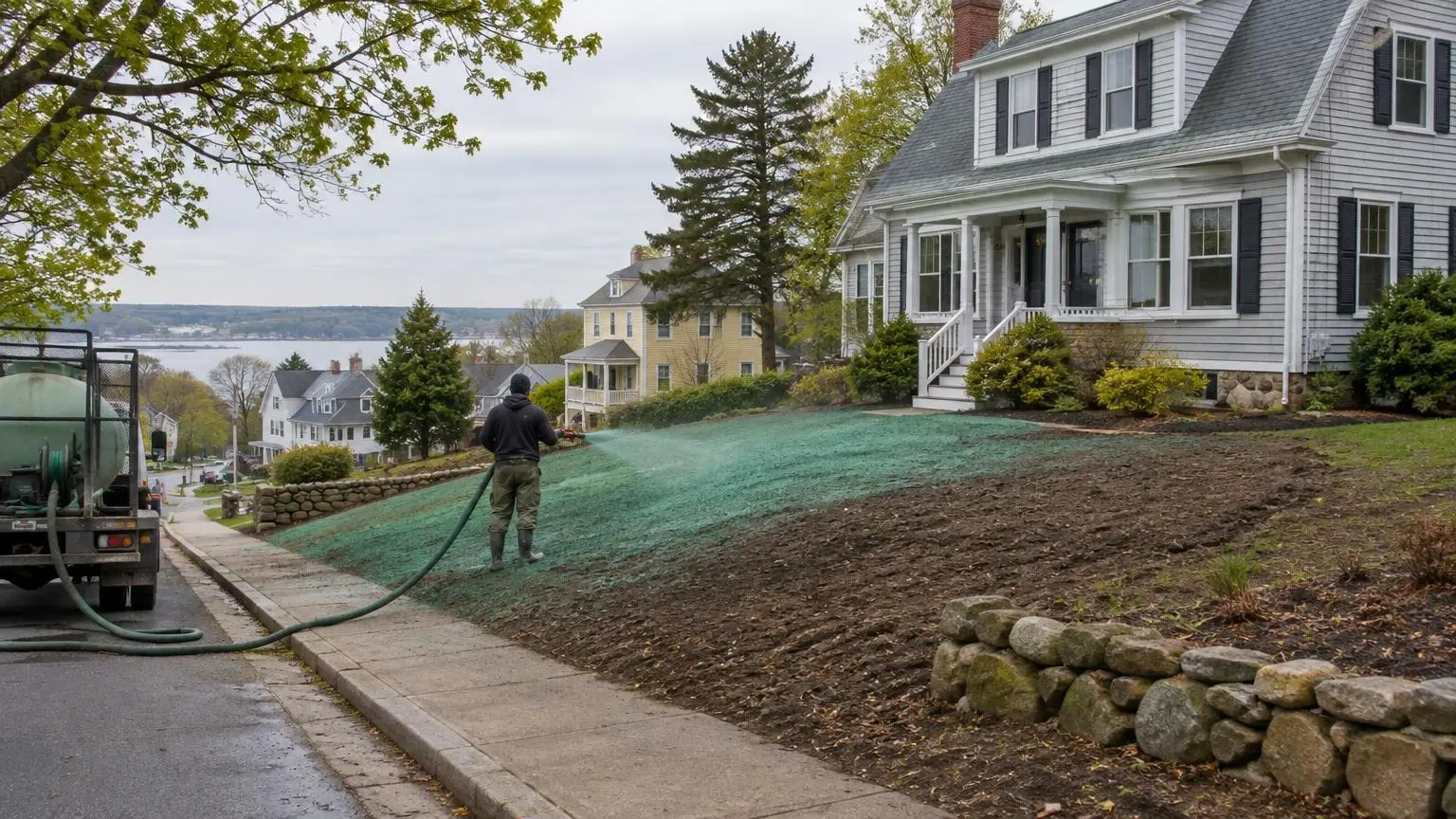
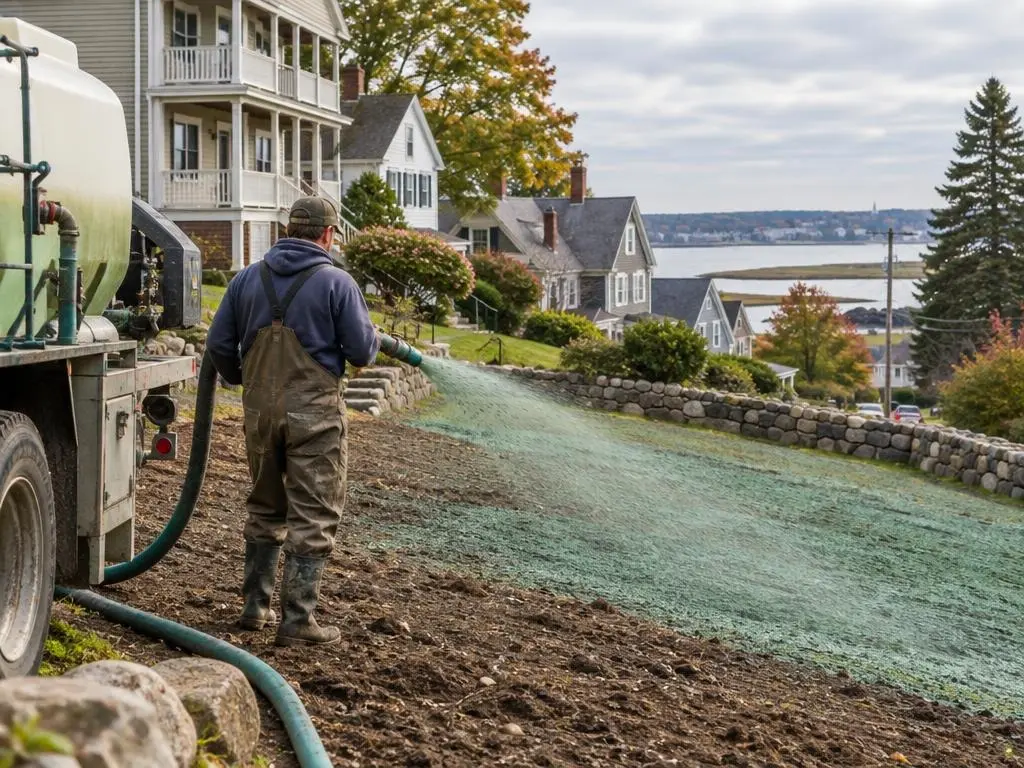
Hydroseeding is how we start most new lawns in Providence and the towns around it. A tank on our truck blends water with grass seed, a fiber mulch made from wood or recycled paper, starter fertilizer and a tackifier that glues it all down, and we spray that slurry across prepared soil in an even green layer. The mulch holds moisture against the seed, the tackifier keeps the mix from sliding off a bank, and the dye shows exactly where coverage is thick or thin. On a city lot, a long hose lets us reach a backyard without driving across it. On a building site, the same rig can cover acres in a day. We use hydro seeding for new lawn installation, lawn repair, steep slopes and construction stabilization, and we do the grading, topsoil and silt fence work that has to happen first.
What the soil is like here
Rhode Island's uplands were built by glaciers, and it shows the moment you put a rake in the ground. The USDA's Narragansett soil series, first described in Kent and Washington Counties in 1934, is a good picture of what we see on many lots: a dark brown silt loam surface over a substratum of very gravelly loamy coarse sand that starts roughly 28 inches down. The USDA calls it well drained, with moderate permeability near the surface and moderately rapid to rapid permeability below. It forms over till on plains, low ridges and hills with slopes up to 25 percent.
In plain terms, the top layer holds water reasonably well, the ground underneath lets it go, and stones turn up everywhere. That is good news for drainage and bad news for a lawn that is seeded on thin topsoil, because roots dry out fast when the silt loam layer has been scraped away by an excavator. Before we spray, we check how much real topsoil is left. If a builder stripped it, we bring screened loam back in so the new grass has more than gravel under it.
Hills, rivers and runoff
Providence covers about 18.4 square miles of land at the head of Narragansett Bay. The Woonasquatucket and Moshassuck Rivers meet downtown to form the Providence River, and the city is one of many that claim to sit on seven hills. Walk any neighborhood on the East Side or Federal Hill and you will see the result: short, steep front banks between the sidewalk and the house, terraced backyards, and driveways that send water toward the street.
Those banks are where dry seed fails. A summer thunderstorm can carry broadcast seed and straw into the gutter in a single afternoon. Hydroseed does better because the fiber mulch and tackifier bind the seed to the surface, and on the steepest pitches we lay an erosion control blanket first and spray over or around it. Everything that washes off a lot here ends up in a storm drain that leads to the rivers and the bay, which is why we take slope stabilization seriously even on small residential jobs.
Weather we plan around
Providence has a humid continental climate that borders on humid subtropical, and it sits in USDA hardiness zone 7a. The 1991 to 2020 normals put the January mean at 29.2 degrees and the July mean at 73.5 degrees, with about 47.54 inches of precipitation and 36.6 inches of snow in a typical year. Rain is spread fairly evenly through the seasons, so a fresh lawn rarely goes long without water from the sky, but heavy storms can still move soil on bare ground.
That pattern shapes our schedule more than anything else. Cool-season grasses like Kentucky bluegrass, tall fescue, fine fescue and perennial ryegrass are what grow well here, and they germinate best when the soil is still warm and the air is cooling off.
When to seed in Rhode Island
For cool-season lawns, late summer into early fall is the main window. Extension services across the cool-season belt agree on this: Iowa State calls mid-August to mid-September the best time to establish a lawn from seed, and the University of Tennessee names late August to mid-October for cool-season turf. Here, we plan most lawn hydroseeding from late August through the end of September, with October work for sunny, sheltered spots.
Spring is the second window. It works, but crabgrass and other summer weeds come up alongside the new grass, and the young lawn has only a few weeks before July heat. We seed spring lawns as soon as the ground can be graded and topsoil is dry enough to work. Midsummer seeding is possible with steady irrigation, but we will tell you honestly when waiting a few weeks gives you a better lawn. Construction stabilization is different: bare ground on a building site needs cover now, so we use a temporary cover crop or a heavier mulch to hold it until the permanent seed can go down.
Sod vs hydroseed vs dry seed
The three ways to start a lawn trade price against speed. HomeGuide prices hydroseeding between $0.12 and $0.35 per sq ft and laid sod between $1 and $4. HomeAdvisor lists broadcast dry seeding at $0.10 to $0.20 per square foot. Sod looks finished by the time the crew drives off, but it is the priciest option and has to be rolled onto well-prepared, level ground, which can be hard to reach on a city lot. Dry seed, the traditional lawn seeding method, is the cheapest, but the University of Nebraska Extension notes that it can take two to three weeks to show, while hydroseeded grass generally becomes visible in five to seven days. Dry seed also has nothing to hold it on a slope.
Hydroseed sits in the middle on price and usually wins on banks, irregular shapes and large areas. It needs regular watering for the first few weeks and a first mow at around four to six weeks, but the result is a lawn that rooted where it grew, with grass varieties chosen for your sun and shade.
Building sites and stormwater
A good share of our work is on construction and renovation projects: new houses, additions, utility trenches, commercial pads and road shoulders. The EPA explains that rain falling on a construction site picks up loose soil and carries it into storm sewers or straight into rivers and coastal waters, and the federal construction rule that every stormwater permit has to meet calls for disturbed ground to be stabilized right away once work halts on it for longer than 14 days. Around Providence, that water heads for the rivers and Narragansett Bay. Our hydroseeding services for builders cover silt fence and inlet protection installed to the job's approved plan, temporary cover that holds a site over a winter shutdown, and the permanent seeding that finishes it.
What a job with us looks like
- A site visit to measure, check soil and slope, and look at access
- A written estimate that lists prep, seed mix, mulch rate and any blankets or silt fence
- Prep: stone and debris removal, fine grading and topsoil where it is needed
- Spraying, with siding, walks and drains protected
- Written watering and mowing instructions
If you have bare ground, a thin lawn or a bank that will not hold, get a free estimate and we will come take a look.
Our Services
Six kinds of work, from a single front yard to a graded subdivision, all aimed at getting soil covered and grass growing.
New Lawn Hydroseeding
A full new lawn sprayed onto graded, loamed soil, with a seed mix chosen for your sun and shade.
Learn more →Builder & Commercial Hydroseeding
Large-area seeding and site stabilization for builders, developers, property managers and public work.
Learn more →Slope & Erosion Control
Blankets, hydromulch and bonded fiber matrix for Providence banks, swales and ditches that lose soil every storm.
Learn more →Silt Fence & Sediment Control
Silt fence, catch basin inlet protection and perimeter controls installed and maintained for building projects.
Learn more →Yard Grading & Loam
Dirt work, yard grading, topsoil (loam) and drainage shaping so new seed has the right ground under it.
Learn more →Lawn Repair & Overseeding
Thin lawns thickened and bare patches rebuilt with aeration, overseeding and spot hydroseeding.
Learn more →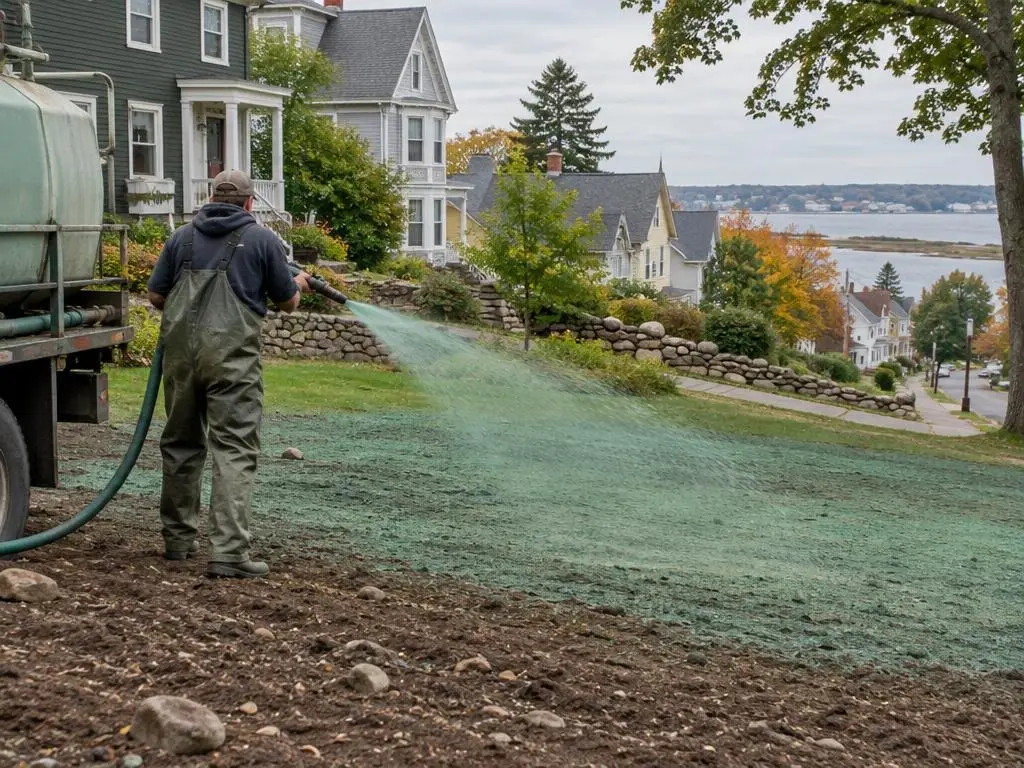
Towns We Seed Around Narragansett Bay
We work in Providence and in the cities that ring it: Cranston, Warwick, East Providence, Pawtucket, Johnston and North Providence. Farther out, Smithfield, Lincoln, Cumberland and Scituate bring hillier ground, reservoirs and bigger lots, while Coventry and West Warwick mix mill villages with open country along the Pawtuxet. Down the bay, East Greenwich and North Kingstown have new building on former farmland, and Barrington, Bristol and Warren sit low on peninsulas between tidal rivers, where sandy and clay soils behave very differently. We also cross the state line into Attleboro, North Attleborough, Seekonk, Rehoboth and Swansea in Massachusetts. Open any town below to read how its soil, water and building patterns change the way we seed and hold ground there.
- Hydroseeding in Providence, RI
- Hydroseeding in Cranston, RI
- Hydroseeding in Warwick, RI
- Hydroseeding in East Providence, RI
- Hydroseeding in Pawtucket, RI
- Hydroseeding in Johnston, RI
- Hydroseeding in North Providence, RI
- Hydroseeding in Smithfield, RI
- Hydroseeding in Lincoln, RI
- Hydroseeding in Cumberland, RI
- Hydroseeding in Barrington, RI
- Hydroseeding in Bristol, RI
- Hydroseeding in Warren, RI
- Hydroseeding in East Greenwich, RI
- Hydroseeding in North Kingstown, RI
- Hydroseeding in Coventry, RI
- Hydroseeding in West Warwick, RI
- Hydroseeding in Scituate, RI
- Hydroseeding in Attleboro, MA
- Hydroseeding in Seekonk, MA
- Hydroseeding in Rehoboth, MA
- Hydroseeding in North Attleborough, MA
- Hydroseeding in Swansea, MA
Why Homeowners Call Hydroseeding Providence
Prep that matches the soil
We check how much topsoil is left on glacial ground and add screened loam where a builder stripped it, instead of spraying seed onto gravel.
Slopes handled properly
Banks get heavier mulch, bonded fiber or an erosion control blanket, chosen by pitch and what sits below them.
Seeding on the right calendar
We tell you when late summer or fall seeding will give you a better lawn than seeding today, and why.
Line-by-line estimates
Square footage, prep, seed mix, mulch and any erosion control are each listed so nothing is buried in one number.
Common Questions
What is the best time to plant grass seed in Rhode Island?
For the cool-season grasses that grow here, late summer to early fall is the main window, roughly late August through September, with some October work in warm spots. Spring is the second choice; it works, but weeds compete harder and summer heat arrives quickly.
Can I hydroseed my existing lawn?
Yes, if the lawn is thin rather than solid. We mow it short, rake or core-aerate so the slurry reaches soil, and spray over it. Where the lawn is mostly weeds or dead patches, we usually recommend a full renovation with grading and new topsoil first.
Is there a downside to hydroseeding?
You do not get an instant lawn the way you do with sod, and the area needs steady watering for about three weeks while seed germinates. The slurry can also stain siding or concrete if it is not masked or rinsed, which is why we protect edges as we spray.
How much does hydroseeding cost around Providence?
National cost guides put residential hydroseeding somewhere between $0.07 and $0.35 per sq ft, and HomeGuide adds that most outfits set a job minimum, typically $300 to $500 or higher. Grading and topsoil are billed on top. Once we have walked the yard we write down one figure, and that signed figure is your bill.
How fast will I see grass?
In warm soil, hydroseeded grass generally shows in five to seven days; Angi's figure is that most hydroseeded lawns are up within 7 to 14 days. Plan on the first cut roughly four to six weeks out, when the blades reach about 4 inches.
Will hydroseed hold on a steep front bank?
Most short banks hold well with a heavier mulch rate and tackifier. On very steep or long slopes we add a blanket, or spray a bonded fiber matrix, to keep seed and soil on the hill through heavy rain.
Can you reach my backyard if there is no driveway access?
Usually. The hose runs from the truck parked on the street, so we can spray behind a house or down a narrow side yard without driving equipment over the lawn.
Have Bare Ground? Let Us Walk It With You
Free site visit, written estimate, and a seeding date that fits the season.